7. 2019 Memorial Day Heat Wave
A heat wave occurred on the weekend of 2019 Memorial Day across the Southeastern U.S.
7.1. Model Configuration and Datasets
The case runs are initialized at 00z May 23, 2019 with 120 hours forecasting. The corresponding namelist options that need to be changed are listed below. The app uses ./xmlchange to change the runtime settings. The settings that need to be modified to set up the start date, start time, and run time are listed below.
./xmlchange RUN_STARTDATE=2019-05-23,START_TOD=0,STOP_OPTION=nhours,STOP_N=120
Initial condition (IC) files are created from GFS operational dataset in NEMSIO format. The GFS reanalysis dataset are used as ‘truth’ to compare with simulation results.
The GFS model EMC global workflow points to the most up-to-date GFS model development code. The GFS.v16.0.10 is tested in C768 (~13km) resolution and in 128 vertical levels. It uses two scripts, setup_expt_fcstonly.py and setup_workflow_fcstonly.py to set up the mode simulation date and case directories.
The case runs are initialized at 00z May 23, 2019 with 120 hours forecasting. The settings that need to be modified to set up the start date and directories are listed below.
./setup_expt_fcstonly.py --pslot 2019MemHeat --configdir /PATH/TO/YOUR/GLOBAL/WORKFLOW/parm/config --idate 2019052300 --edate 2019052300 --res 768 --comrot /PATH/TO/YOUR/EXP/DIR/comrot --expdir /PATH/TO/YOUR/EXP/OUTPUT/expdir
The account and simulation duration time can be set up in /expdir/2019MemHeat/config.base file.
./setup_workflow_fcstonly.py --expdir /PATH/TO/YOUR/OUTPUT/expdir/2019MemHeat
Next step is to go to /expdir/2019MemHeat to submit the run by
crontab 2019MemHeat.crontab
7.2. Case Results
7.2.1. Synoptic Dynamics
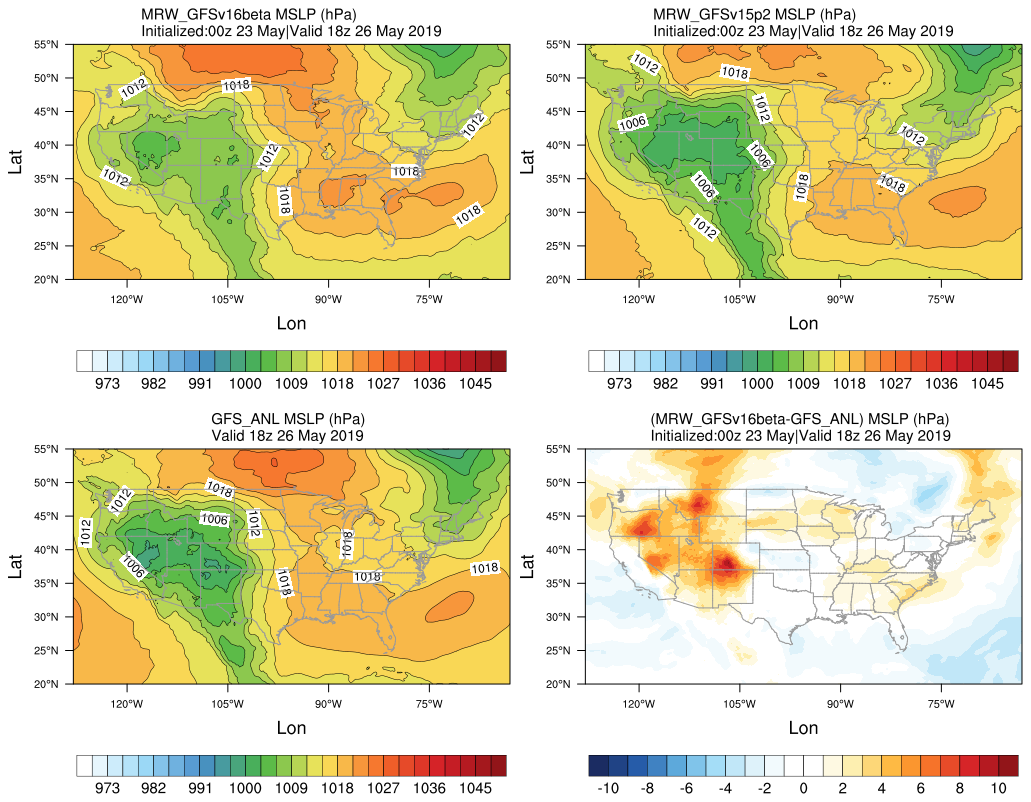
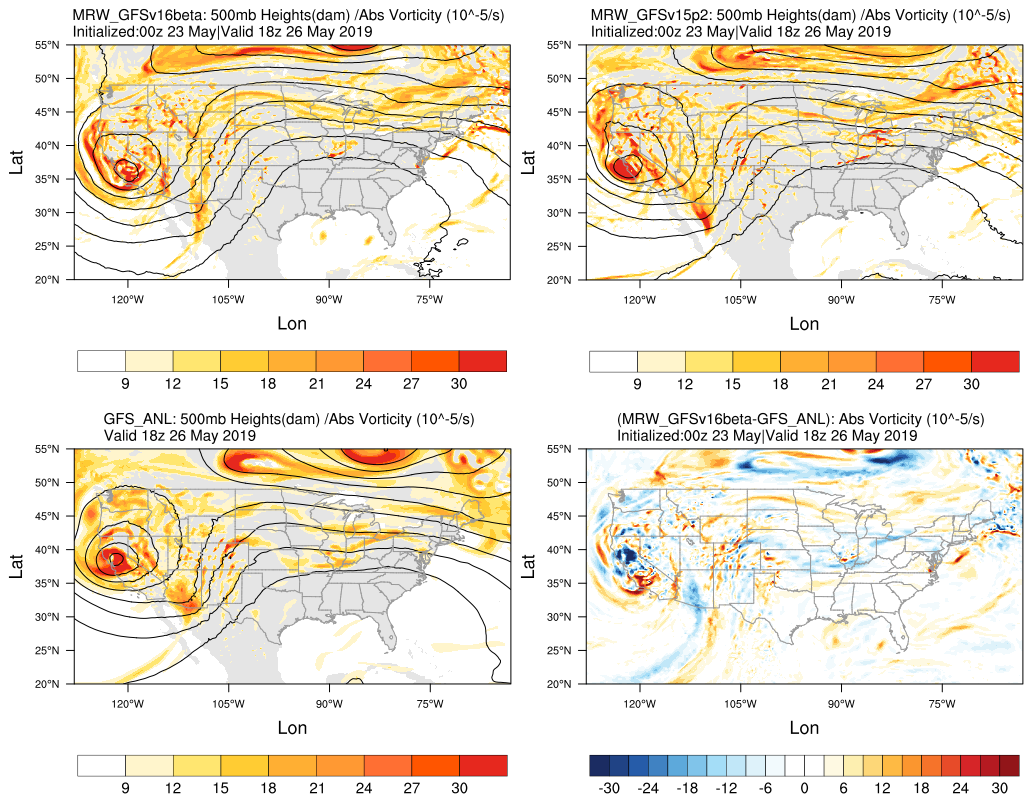
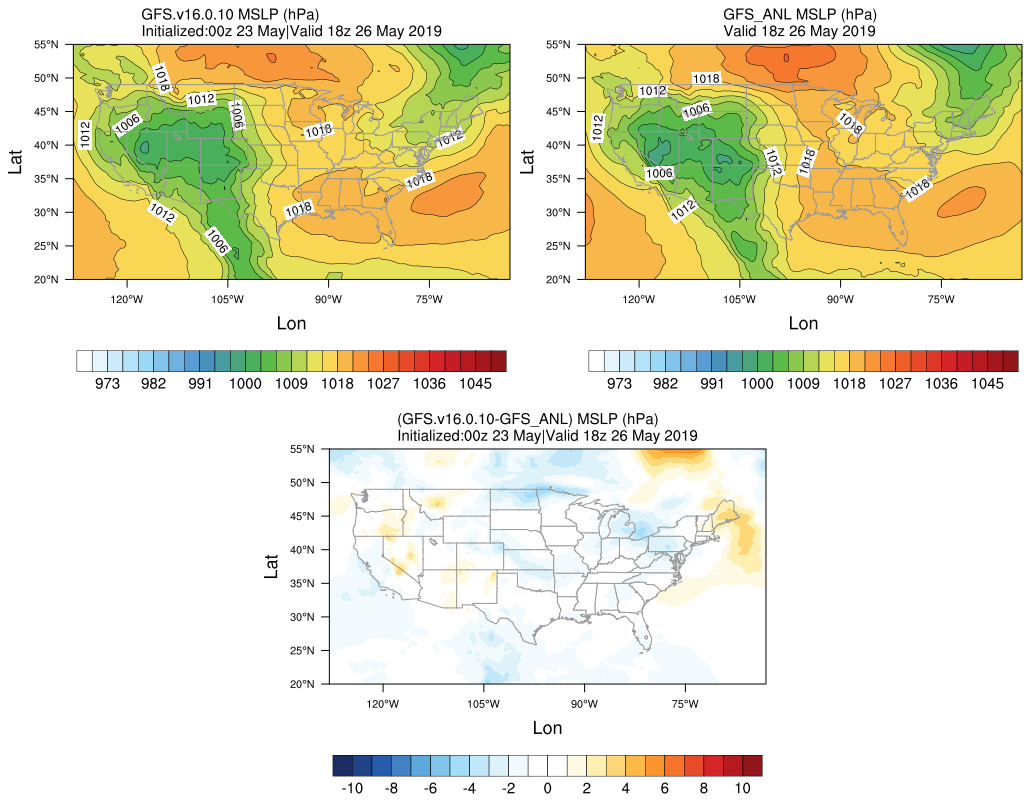
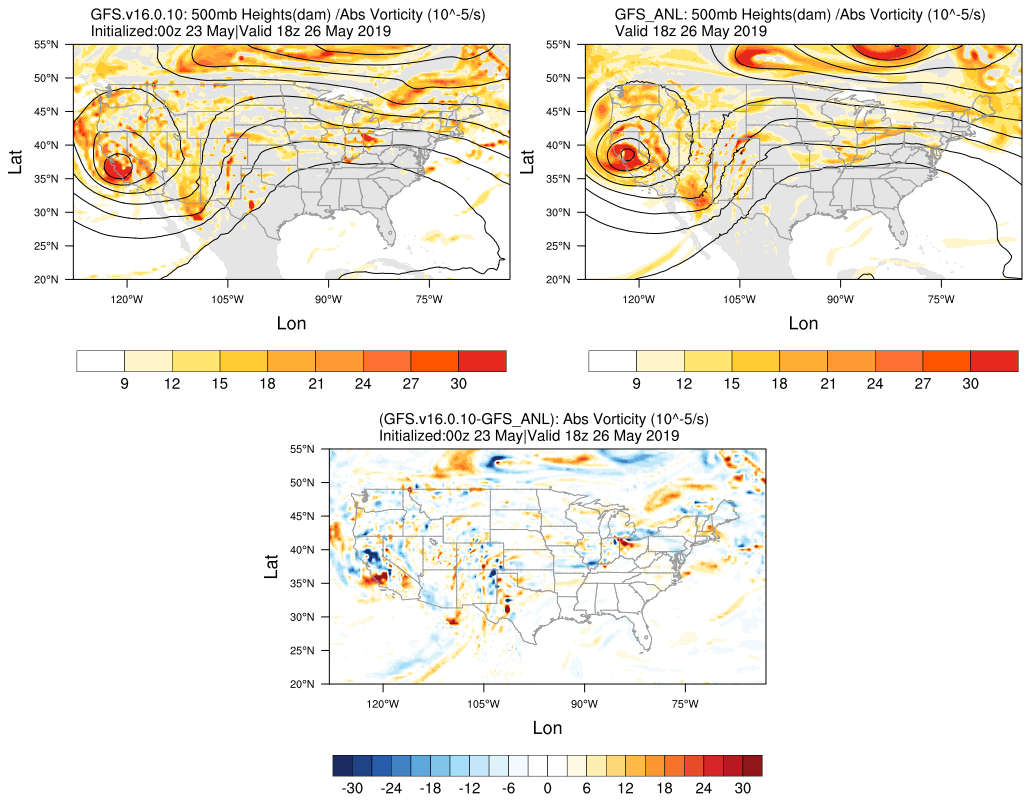
7.2.2. Surface Temperature
7.3. Summary and Discussion
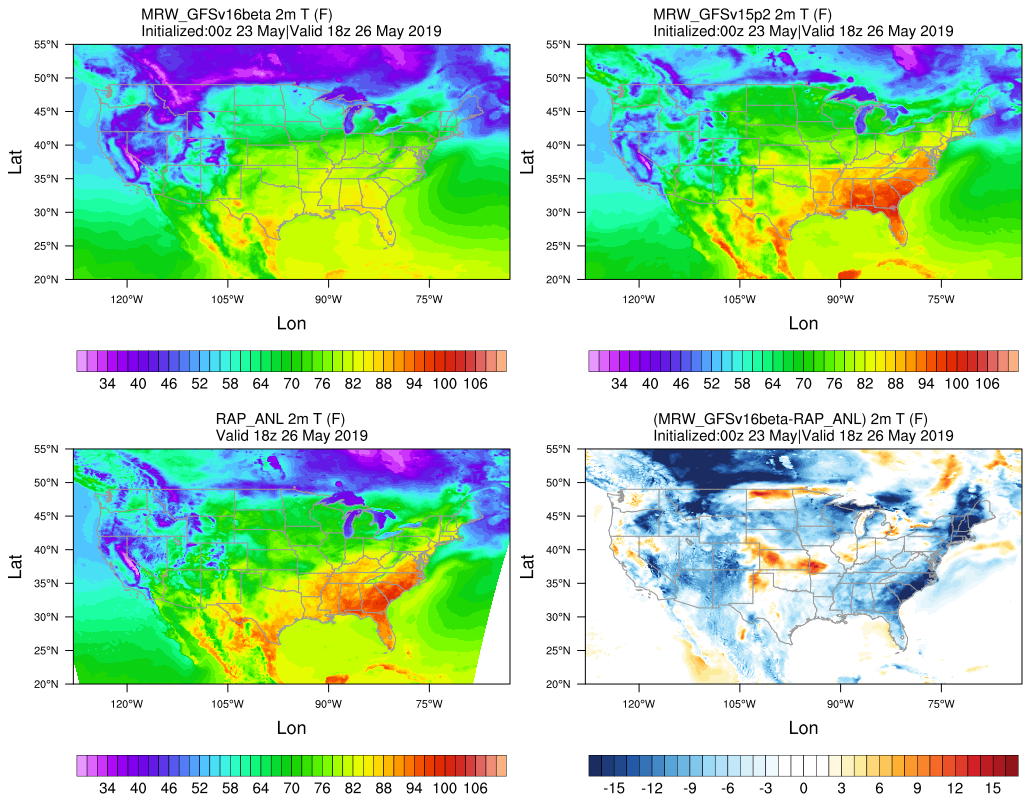
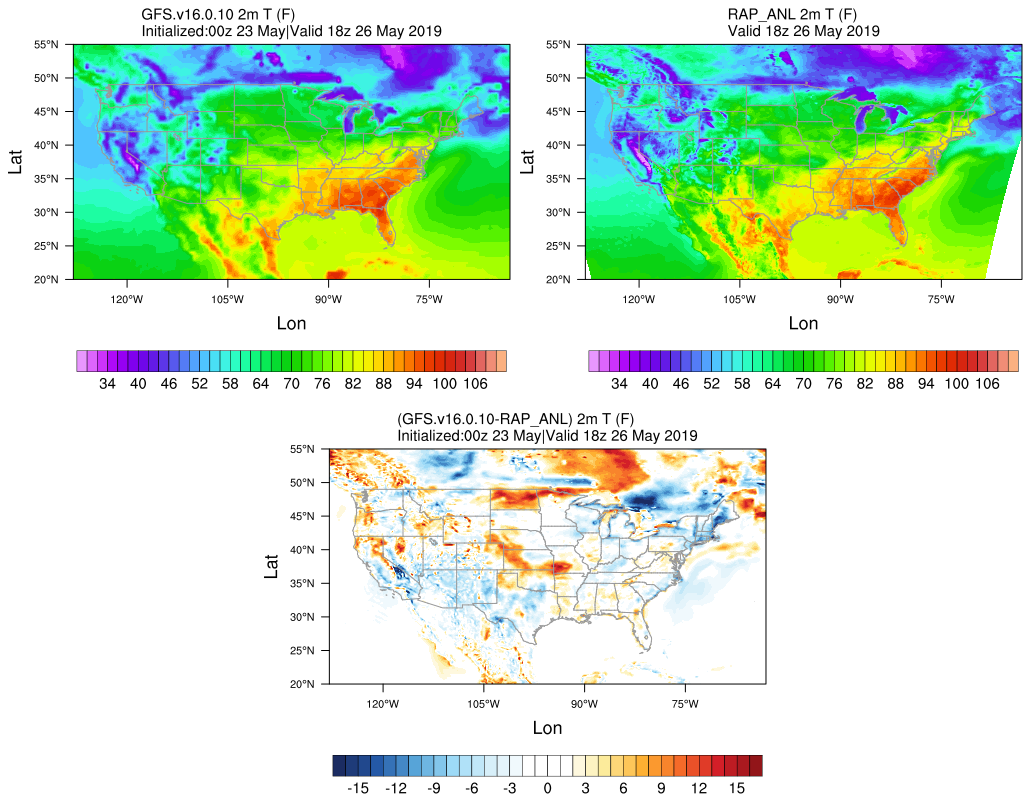
MRW_GFSv16beta generates a cold bias for 2-m temperature over most of CONUS during the 2019 Memorial Day Heat Wave event. However, both MRW.GFSv15p2 and GFS.v16.0.10 simulate the extreme temperature well over the Southeastern U.S. This means that the cold bias of this extreme temperature case in the GFS model is already fixed in the following physics developments (see Timeline of physics frozen for the different model versions).
